
Soups & Stews
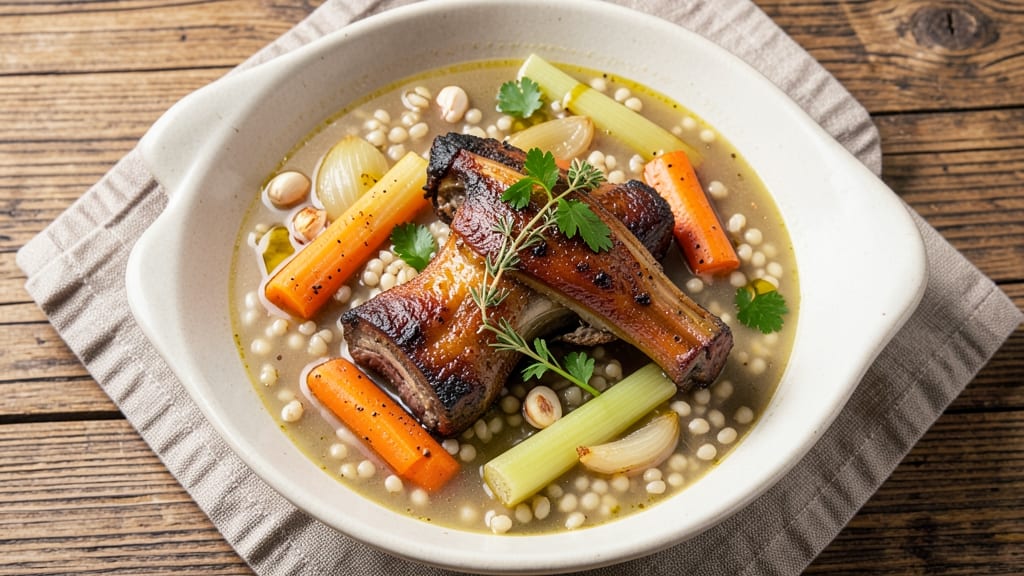
Slow-simmered beef bones unlock deep umami richness that transforms simple barley into a nourishing, restaurant-quality soup. This recipe builds flavor through hours of gentle cooking, where collagen-rich bones melt into a velvety broth that coats every tender barley grain.
The secret lies in patience—letting the broth develop complex layers while vegetables soften and barley absorbs all that savory goodness.
What sets this soup apart is the balance of textures: hearty beef chunks that pull apart easily, chewy barley grains, and wilted vegetables that release their sweetness into the broth. The technique is straightforward but essential—skimming impurities, seasoning carefully, and simmering uncovered to concentrate flavors.
This is comfort food at its finest, the kind that warms you from the inside out during cold weather.
By the final spoonful, you'll taste the reward of slow cooking: a broth so rich it coats your spoon, barley that's perfectly tender but still holds its shape, and beef that's melt-in-your-mouth tender.
The aroma alone will have everyone gathering around the table, and each bite delivers that deep, satisfying umami that defines this classic dish.
Serve with crusty bread to soak up every last drop of that flavorful broth, or pair with a simple green salad to balance the meal. The beauty of this recipe is its adaptability—add mushrooms for earthiness, fresh herbs for brightness, or a splash of vinegar for acidity.
Here's how to create a soup that feels like a hug in a bowl.
Ingredients for beef bone barley soup
Six hearty ingredients build this soul-warming soup—beef bones for depth, barley for chew, and aromatic veggies for balance.
| Ingredient | Amount | Notes |
|---|---|---|
| Beef Bones 🦴 | 4 lb | Knuckle or marrow bones preferred |
| Pearl Barley 🌾 | 1 ½ cups | Uncooked, rinsed well |
| Yellow Onions 🧅 | 2 whole | Peeled, halved lengthwise |
| Carrots 🥕 | 4 pieces | Peeled, cut into 1-inch chunks |
| Celery Stalks 🧅 | 4 whole | Trimmed, cut into 1-inch pieces |
| Garlic Cloves 🧄 | 6 cloves | Peeled, smashed slightly |
| Tomatoes 🍅 | 4 whole | San Marzano canned, crushed |
| Bay Leaves 🌿 | 2 whole | Fresh preferred |
| Fresh Thyme 🌿 | ½ ounce | Or 1 tbsp dried thyme |
| Black Peppercorns 🌶️ | 1 tbsp | Crushed lightly |
| Sea Salt 🧂 | 2 tbsp | Diamond Crystal preferred |
| Olive Oil 🫒 | ¼ cup | Extra-virgin for richness |
| Fresh Parsley 🌿 | ¼ cup | Chopped, for garnish |
The beef bones are non-negotiable here—knuckle or marrow bones melt into the most flavorful broth. Costco or butcher shops usually have them in bulk, and they're worth the splurge. Look for bones with good marrow content—they'll be heavier and have a slightly yellowish tint. If you can't find beef bones, pork femurs or veal shanks work in a pinch, but beef is the star. The pearl barley? Bob's Red Mill is my go-to brand—it stays firm and absorbs all that umami goodness.
No fresh thyme? Dried works at one-third the amount, but fresh has that bright, herbal note. Short on carrots? Substitute with parsnips or sweet potatoes for a different twist. The tomatoes can be fresh too—just peel and crush them. Want more depth? Add a splash of balsamic vinegar or a pinch of smoked paprika. The olive oil matters here—use something with good fruity notes. Trader Joe's or Whole Foods carry excellent extra-virgin options that won't overpower the broth.
Broth freezes beautifully—portion into ice cube trays for easy reheating later. The barley keeps for 3-4 days in the fridge, but the broth gets better with time. I always make a double batch—one for dinner, one for lunches. Store the bones separately if you want to make more later—they'll keep in the freezer for up to 3 months. The parsley garnish is optional but adds that fresh pop of color—skip it if you're serving immediately.
Why You'll Love This Recipe
- Throw-In Ingredients: I swear by the "dump-and-go" approach here—just toss in the beef bones, barley, onions, carrots, and celery, then let the slow simmer do the work. No fancy techniques, no hovering over the stove like some kind of sous chef.
- Rich Umami Bomb: That beef bone broth? Chef’s kiss. The marrow melts into the barley, turning every spoonful into a deep, savory hug—like someone simmered love into the pot. (Honestly, I’ve caught myself eating it straight from the spoon.)
- Meal Prep MVP: This soup tastes better the next day, which is perfect because it’s basically my freezer’s best friend. Freeze portions for lazy nights or pack it for work—just reheat, and boom, restaurant-quality comfort.
- Budget Booster: Beef bones and barley stretch this recipe into a whole week’s worth of meals without breaking the bank. I’ve made four lunches out of one pot, and my wallet’s still breathing easy. (Yes, even on a Tuesday night.)
Step-by-step instructions for beef bone and barley soup
This rich, umami-packed soup comes together through patience and layering flavors. Let's build it the right way.
Sear the Beef Bones for Maximum Flavor
Preheat your oven to 450°F. Heat 0.25 cup olive oil in a large Dutch oven over medium-high heat. Place the 4 lb beef bones in the pot, bone-side down, and sear for 10-12 minutes until deeply browned on all sides. This step develops the rich, meaty foundation of your soup.
Real talk: don't rush this. You want those bones to develop a dark crust—this is where all the umami magic happens. Flip them carefully with tongs, working in batches if needed. Once all sides are browned, remove the bones and set aside in a bowl.
Sauté the Aromatic Vegetables
In the same Dutch oven, add the halved yellow onions, carrots, celery stalks, and smashed garlic cloves. Cook over medium heat for 8-10 minutes, stirring occasionally, until the vegetables soften and the onions turn translucent. You'll smell that sweet, caramelized aroma—this is your soup's flavor base.
Here's the thing—don't overcrowd the pot. If your vegetables aren't fitting comfortably, cook them in batches. You want them to brown slightly rather than just steam. Once they're ready, add the crushed black peppercorns and cook for another 30 seconds to toast them lightly.
Build the Soup Base
Return the browned beef bones to the pot. Add 4 whole tomatoes, 2 bay leaves, and 0.5 ounce fresh thyme. Pour in enough cold water to cover everything by about 2 inches—you'll need roughly 8-10 cups total. Bring to a boil, then reduce heat to low and skim off any foam that rises to the surface.
This skimming step is crucial. It removes impurities that can make your broth cloudy. Once the foam subsides, add the 1.5 cups pearl barley and 2 tbsp sea salt. The barley will absorb liquid as it cooks, so don't worry if it doesn't look fully submerged at first.
Simmer for Deep Flavor Development
Transfer the pot to your preheated oven and cook uncovered at 325°F for 3-4 hours. This slow cooking transforms tough bones into melt-in-your-mouth goodness. Check the liquid level occasionally—add water if it drops below 2 inches above the ingredients.
You'll know it's ready when the meat easily pulls away from the bones and the broth has a rich, velvety consistency. The barley should be tender but still hold its shape. If you're impatient, you can finish the last 30 minutes on the stovetop over low heat.
Finish and Serve
Remove the beef bones and strain the broth through a fine-mesh sieve into a clean pot. Discard the bones and vegetables, but save the barley. Return the broth to the pot and stir in the barley. Taste and adjust seasoning—you might need a bit more salt or pepper to balance the flavors.
Ladle the hot soup into bowls and garnish each serving with 0.25 cup fresh parsley. Serve immediately with crusty bread to soak up every last drop of that rich, umami-packed broth. The barley will continue to absorb liquid as it cools, so serve it piping hot for the best texture.
Pro Tips For Making Beef Bone Barley Soup
- BLANCH BONES FIRST: Skip the raw bone soak—blanching in boiling water for 5 minutes removes impurities and speeds up flavor extraction. I used to skip this, and the broth always tasted murky until I tried it. (Yes, even if you’re impatient like me.)
- SIMMER LOW AND LONG: Don’t rush the barley—keep the soup at a bare simmer (tiny bubbles, not rolling) for at least 45 minutes. I’ve burned barley twice now, and it turns to mush instead of creamy. Trust the slow cook.
- CHOP VEGETABLES UNIFORM: Cut onions, carrots, and celery into ½-inch chunks so they cook evenly. My first attempt had giant celery stalks still crunchy while the onions dissolved—now I measure and chop like it’s my job.
- USE COLD BARLEY: Add pearl barley straight from the fridge to cold broth—it absorbs liquid faster and cooks more evenly. I learned this the hard way after clumping barley ruined a batch. (Your future self will thank you.)
Common mistakes when making perfect results
Skipping the Sear
This is the biggest rookie mistake—skipping the sear on your beef bones. Without that deep, browned crust, your broth will lack that rich, meaty depth that comes from the Maillard reaction. I've made this error myself, and the difference is night and day.
Take the extra 10-12 minutes to properly sear each bone side. If you're short on time, at least brown them in batches. 🔥
Not Skimming the Foam
That first foam that rises when you bring the broth to a boil contains impurities that can make your soup cloudy and bitter. Skimming it off is non-negotiable—use a fine-mesh skimmer or a ladle.
I like to skim for about 5 minutes after boiling begins. This step might feel tedious, but it's what separates a good broth from a great one. Trust me, your soup will thank you.
Overcrowding the Pot
When sautéing your vegetables, don't overcrowd the Dutch oven. If your onions, carrots, and celery are packed in too tightly, they'll steam instead of develop that beautiful caramelized flavor. Cook them in batches if needed.
This might add 5-10 extra minutes, but the flavor payoff is worth it. The same goes for the barley—give it room to absorb the broth properly.
Ignoring the Liquid Level
During the long simmer, the liquid level will drop as the bones render fat and the vegetables release moisture. If you let it get too low, your barley will dry out and your broth will concentrate too much.
Keep an eye on it and add hot water (not cold) to maintain at least 2 inches of liquid above the ingredients. I check it every 30 minutes during the oven phase.
Rushing the Cook Time
This soup needs 3-4 hours of slow cooking to develop its full depth of flavor. Cutting it short means you'll end up with broth that's still raw-tasting and barley that's mushy. I know time is precious, but resist the urge to speed it up.
If you're really pressed, you can finish the last 30 minutes on the stovetop, but don't skip the full oven time. Patience here is your friend.
Forgetting to Taste and Adjust
After all that cooking, it's easy to just serve the soup as-is, but take a moment to taste it before serving. You might need to adjust the seasoning—perhaps a pinch more salt, a crack of black pepper, or even a splash of lemon juice to brighten it up.
I always taste the broth before adding the barley back in, so I can adjust before it absorbs all the flavors. This final step makes the difference between good and extraordinary. ✨
Nutrition facts
Frequently asked questions
Can I use regular barley instead of pearl barley?
Pearl barley is ideal because it holds its shape beautifully in soup, but you can substitute with regular barley if needed. Just note that it may break down more and become softer. For a similar texture, try pot barley or hulless barley—both stay firmer during cooking. If using regular barley, reduce cook time by 15-20 minutes since it softens faster.
How do I make this soup vegetarian?
Swap the beef bones for mushroom stems or hearts (soaked first) and vegetable broth. Add 1 cup dried lentils or chickpeas for protein, and boost umami with 1 tbsp soy sauce or 1 tsp miso paste. The barley will still absorb the flavors beautifully, though the broth will have a different depth. Consider adding smoked paprika for richness.
Why does my barley get mushy?
Overcooking is the most common cause—barley should be tender but still hold its shape. For 3-4 hours of simmering, check it at 2.5 hours and taste. If it's too soft, reduce cook time next batch. Also, ensure you're using enough liquid (at least 2 inches above ingredients) and avoid stirring the barley constantly, which breaks it down faster.
Can I make this soup in an Instant Pot?
Yes! Sear the bones first, then sauté veggies. Add everything (including barley) and pressure cook for 90 minutes on high. Natural release for 15 minutes, then adjust seasoning. The Instant Pot will give you tender meat and barley, but the flavor depth won't match the slow oven method. For extra richness, add 1 cup beef stock at the end and simmer 10 minutes uncovered.
What's the best way to store leftovers?
Let the soup cool completely, then store in airtight containers for 4-5 days in the fridge. For longer storage, freeze portions for up to 3 months. The broth freezes beautifully—portion into ice cube trays for easy reheating. When reheating, warm gently on the stovetop (don't boil) to prevent barley from becoming mushy. Stir in a splash of water if needed.